Archive Record
Images
Metadata
Title |
A Trooper's Reminiscences by Benjamin Boisseau Vaughn |
Dates of Creation |
May 27, 1894 |
Scope & Content |
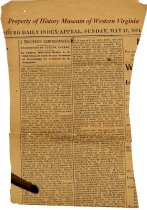
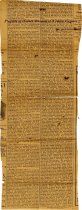
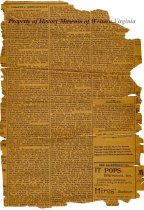
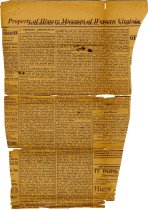
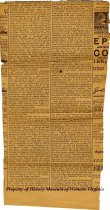
Object ID 2009.75.220 is a duplicate of this newspaper article. Object ID 2009.75.026 - The content of the object ID referred to is a one-page entry that is in pieces, but is part of this same newspaper article, which is the same as page 5. Page 3 and 4 are duplicates, but the second image has more of the article on the right top. The newspaper is split into smaller portions where it was folded. Vaughan was a trooper in the 1st Virginia Cavalry, Wickham's Brigade, Fitzhugh Lee's division. He starts his reminiscence camped near Hamilton's Crossing in May 1864. He tells the tale of a 16 year old boy from Amelia County named "Wingo" who had just joined the regiment. In order to indoctrinate him, the trooper's instigated a confrontation between him and a much larger and older man named "Godsey", which led to duel. The weapons of choice were carbines, which had been previously loaded with blanks. Wingo fooled them all by declaring that he preferred to load his own weapon, thus terminating the prank. Not long after this incident both "Wingo" and "Godsey" were captured. It is said that "Wingo" was taken before General Sheridan, who questioned him about Lee's army. In response, "Wingo" gave vague answers that revealed nothing. On the 4th of May, Union General Grant crossed the Rapidan River and Vaughan, along with his company, rode on to the Wilderness. Vaughan relates that on the 5th, Confederate Gen. J. E. B. Stuart's cavalry led the advance of Confederate Gen. A. P. Hill's Corps down the plank road toward the enemy, and that Confederate General Rosser encountered Union General Wilson at Todd's Tavern. Note: Wilson was a cavalry general in the Western theater, and it is believed this should be General Gregg instead. On the 6th and 7th both armies were in conflict and the race was on to reach Spotsylvania C. H. Vaughan reflects on the fight around Todd's Tavern and the loss of some good men. His friend and relative Robert Frank Vaughn received an injury to his upper lip which bled profusely. As an aside Vaughn tells us that Robert Frank Vaughan died at the Battle of Winchester on September 19, 1864, and is buried in the Stonewall cemetery in Winchester. The night of the 6th the troop rested in the woods and cared for their animals. He tells us nothing special happened on the 7th, but on the 8th fighting commenced early. Their troop was in support of the 4th Virginia Cavalry and Vaughan could see their dead and wounded being brought back, and saw Major Strother with a terrible cheek wound. Vaughan's regiment were redeployed and moved forward. He could see the enemy's lines and a constant skirmish fire was sustained. After being pulled back from the enemy's front, and within sight of a large road, he saw Gen. Fitz Lee sitting on his horse at a crossing of the roads. The 4th Virginia Cavalry cheered as they saw him. After going a short distance Vaughan saw a sight that gladdened his heart. It was a column of infantry going into line of battle on the other side of a field. He watched as the enemy came marching across the field. Thinking that only cavalry skirmishers were in their front, they were stunned when, at close range, the Confederate infantry opened fire, sending them back into the woods. The infantry were part of Kershaw's and Humphrey's brigades, and the Union forces were composed of Warren's 5th Corps. During the day, as the infantry marched by, many of the troopers saw friends and acquaintances. Frank Vaughan had seen his brother Floyd of the 44th Virginia infantry. He too would be killed, thus their father would lose two sons. On the night of the 8th, the company went into bivouac where Vaughan saw a man named "Parrott", who had recently reported into the company, sitting alone. He was between the ages of 35 and 40, nicely dressed, and had all new equipment. Because of his name he had attracted the men's attention and comments, such as - "Polly want a cracker", and "Pretty Polly" which he took in good humor. The next day, which was the 9th, there was brisk skirmishing in the vicinity of Spotylvania C. H. The troops were dismounted and sent forward across an old field of broomstraw and pine. Behind a fence were enemy sharp-shooters and others on their left. General Stuart rode up and his presence made the bullets come even faster. The order to charge was given and the men rushed forward with a yell. The enemy ran back and the troopers followed into similar fields, where they were met with a stunning volley from an infantry line of battle. Vaughan and the other troopers were forced to run back as the bullets knocked up the dust in the fields they had previously covered. Reaching safety, Vaughn lay down, out of breath, glad not to have been shot. His friend Frank reported that three of their company were killed, including Parrot and one of the Sanderson brothers. The brother who survived completely broke down, and Vaughan could not remain, so walked away leading his horse. As the two armies faced each other at Spotsylvania C. H., General Sheridan's well-equipped cavalry were massed in the rear of the Federal army. They were preparing to make a raid around General Lee's right flank in order to break communications with Richmond. With about 10 to 12,000 cavalry, and artillery, Sheridan moved to Hamilton's Crossing and then onto Telegraph Road heading for Richmond. General Stuart sent General Gordon to follow Sheridan's rear, and Gen. Fitz Lee with Wickham's and Lomax's brigades to interpose [intercept?] Sheridan at Yellow Tavern six miles from Richmond. Vaughn tells of an incident on the road that led toward Richmond in which his company (the rear company) was told that a small body of the enemy was coming down the road. Hiding in the woods, Vaughn's company waited for the enemy to pass so they could close on their rear and chase them. Soon 25 enemy cavalry came in sight and stopped to water their horses. The horses sensed the Confederate presence and went into a panic, scampering back from whence they came. One fellow fell from his horse and was captured. His speech indicated his foreign birth. This little episode, kept Vaughan's company out of some brisk fighting that was going on ahead. The 6th Ohio and the 1st New Jersey Cavalry made a determined stand. Confederate General Wickham attacked. Matthew's squadron of the 3rd Virginia pierced the enemy's lines, but were overwhelmed. Mathews was mortally wounded and there were five killed, three wounded and ten captured. There was almost constant skirmishing during the hard march to Yellow Tavern. Vaughan reached Yellow Tavern on the eleventh of May and relates the afternoon battle. Confederate General Stuart was now with Fitz Lee, with Wickham's and Lomax's brigades on the field, with some of Breathed's artillery. All were dismounted except part of the 1st Virginia Cavalry who were in reserve along with Vaughan. Moving toward the front Vaughn could hear the rattle of carbines, as he came into their range. His commander ordered them to dismount, but soon a courier's arrival changed the order, and they proceeded to the front via the Telegraph Road. After getting organized, another message arrived, and the squadron were ordered to run to the front. The mounted portion met the enemy's charge and the dismounted men got to work among them. Vaughan, on foot with shirt sleeves rolled up, used his carbine repeatedly. During this engagement, Vaughn witnessed the death of Major Granger, of the 7th Michigan cavalry, who was shot in the head and heart. Vaughan and his comrades had positioned themselves along the embankment of a deep cut in the road, and, as the enemy came through, kept up a merciless fire on them from a few feet away, down in the bed of the road. General Stuart was personally directing the fight, and being in the midst of them, would point out which man to shoot. It was at this location that Stuart received his mortal wound. He left the field on his horse, supported by two soldiers on either side of him, and left Fitz Lee in command. An enemy trooper, while running on foot, turned as he passed Stuart and discharged his pistol. Norvell Harris, a comrade of Vaughan, remembers seeing the dust or lint fly from Stuart's coat where the bullet struck him. Late in the afternoon the dismounted men left the scene of action in good order and returned to their horses. It was getting very dark. Soon rain, lightning, and thunder enveloped the troopers, and probably saved them from the enemy's artillery as they crossed the Chickahominy flats. Vaughan was sent off on a duty but soon lost his way in the darkness, and rode along the road hoping to find some of his command. He heard artillery wheels rumbling and with the aid of the lightning saw a battery of several guns in motion ahead. Getting closer he heard the accent of the drivers and, having not been noticed, he turned off into the woods. Taking another direction, he sighted the glow of camp fires and fortunately found them to be those of Wickham's brigade, which company he soon joined. The next day, May 12th, much work lay ahead. In another skirmish with the enemy, the command lost another valuable officer, Col. Randolf of the 4th Virginia Cavalry. The announcement of Stuart's death was taken with great sorrow in the ranks, and to General Lee his fall was a grievous blow. Vaughan's closing words reflect his great pride in serving with the Army of Northern Virginia. |
Year Range from |
1894 |
Creator |
Vaughn, Benjamin Boisseau |
Year Range to |
1894 |
Subjects |
Acquaintance Advance Aprons Artillery (Weaponry) Bivouac Bivouack Blankets Blood Box Breastworks Breath Bridges Bridles Brigade Brothers Buckles Bushes Cab companies Camp Campaigns & battles Carbines Careers Cartridge Cavalry Charge [military] Cheer Church Civil War Civil war battles Clouds Coat Coffee Colonel Column, [military] Communication Company Comrades Confederate officers Confederate soldiers Conversation Cornmeal Corps Courier Crackers Danger Destination Diary Dilemma Dust Duty Earth Embankments Enemy Equipment Farm houses Fatigue Fish Flank Friends Grief Gum cloth Guns Handkerchiefs Haversack Hearts Heroes Hills Holster Horses Humor Infantry Intersections Jackets Knife Lawyers Leaders, Military Leg Line (military) Line of battle Lint Love March, Military Meat Memory Message Moustaches Movement Muskets Muzzle (gun) Narrative Peace Picket line Pickets (Guards) Pines Pistols Powder Raid Rain Rations Rear (military) Regiments Reminiscences Report Reserve Rivers Roads Sabre Saddles School mates Sharpshooters Shells (Ammunition) Shirts Shoe industry Shot Skirmish Skirmishers Sleep Soil Soldiers Squad Squadron Staff officer Stomachs Stragglers Telegrams Thunderstorms Tree Troopers Trot Underbrush Uniforms Veterans Volley Weapons Wheels Woods Wounded Wrist Yankee Yelling |
Search Terms |
1st Army Corps 1st New Jersey Cavalry 1st Virginia Cavalry 3rd Virginia Cavalry 44th Virginia Infantry 4th Virginia Cavalry 5th Corps 5th Virginia Cavalry 7th Michigan Cavalry A. P. Hill Camp of Confederate Veterans Amelia County, Virginia Army of Northern Virginia Chickahominy River Civil War Confederacy, the Confederate Army Confederate Veterans Fifth Corps Fifth Virginia Cavalry First Army Corps First New Jersey Cavalry First Virginia Cavalry Fitz Lee's Division Fort Stonewall Jackson Forty-Fourth Virginia Infantry Fourth Virginia Cavalry Hamilton's Crossing Haskell's Battalion Humphrey's Brigade Kershaw's Brigade Petersburg, Virginia Point Lookout Prison, Maryland Port Republic, Virginia Rapidan, [River] Rappahannock River Richmond, Virginia Seventh Michigan Cavalry Spotsylvania County, Virginia Stonewall Cemetery Telegraph Road Third Virginia Cavalry Todd's Tavern Virginia Military Institute War Between the States War Talks of Confederate Veterans Wickham's Brigade Wilderness, The Winchester, Virginia Yellow Tavern |
People |
Alexander, Edward Porter Anderson, Richard H. Bernard, Geo. S. Bernard, George S. Blanton, James Anderson (Jim) Breathed, James Briggs, George R. Burton, Sidney Butler, Benjamin F. (Beast) Maj. Gen. Carter, James Hill Cook, John Esten Custer, [George A.] Davis, Jefferson Dorsey, Gustavus Warfield (Gus) Field, William Meade Fowlkes, Adrian (Bullet) Godsey, William Archer Gordon, James [Byron] Granger, (Major) Grant, [Ulysses S.] Halleck, Henry Wager Hammond, George Newkirk Harr, Norvell [Harris) Harris, Norvell W. Haskell, John C. Hill, Ambrose Powell Humphrey, Benjamin Grubb Jackson, Stonewall [Thomas J.] Jackson, Thomas Jonathan Jackson, William Kershaw, [Joseph Brevard] Lee, Fitz Lee, Fitzhugh Lee, Robert Edward Lomax, [Lunsford Lindsay] Longstreet, James Mason, Willie Mathews, [George H.] Matthews, George H. McClellan [Major] Merritt, Wesley, General Morgan, [William A.] Parrott, James T. (Burton) Pate, Henry Clay Randolph, Robert Rosser, Thomas Lafayette Sanderson, George L. Sanderson, John B. Scruggs, Joseph A. Sheridan, [Philip H.] Southall, James Southhall, Francis Winston (Frank) Spears, Walter Strother, J. F. Stuart, James Ewell Brown (J.E.B.) Taylor, Richard Torbert, Alfred Thomas Archimedes, General Vaughan, Benjamin Boisseau Vaughan, Floyd Vaughan, Robert Frank Vaughn, B. [Benjamin] B. [Boisseau] Warren, Gouverneur Wickham, [William Carter] Wingo, Elmore E. |
Event |
Civil War |
Collection |
George S. Bernard Collection |
Imagefile |
023\200975073.JPG |
Number of images |
5 |
Object Name |
Letter |
Object ID |
2009.75.073 |
Extent of Description |
5 pages (one duplicate), sizes of individual pages vary. |