
Archive Record
Images
Additional Images [24]
Metadata
Title |
Artillery Experiences at Petersburg & Elsewhere by Dr. Joseph W. Eggleston |
Dates of Creation |
January 3, 1895 |
Scope & Content |
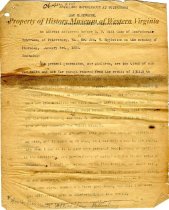
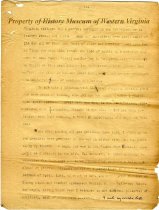
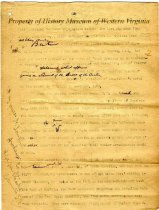
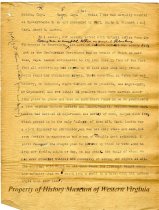
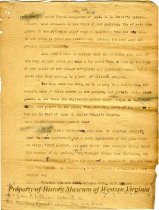
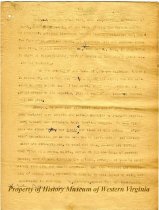
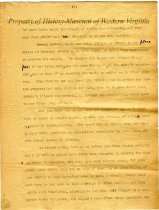
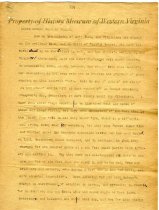
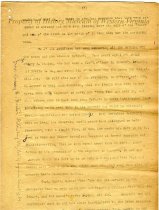
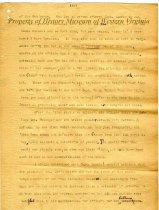
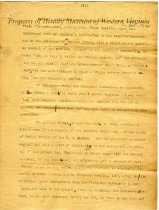
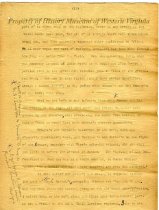
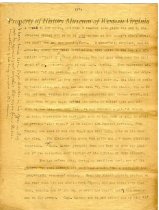
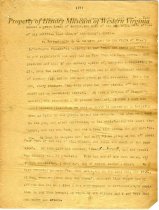
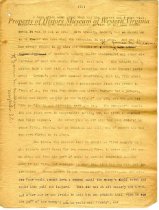
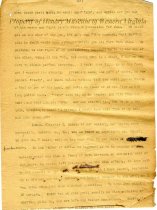
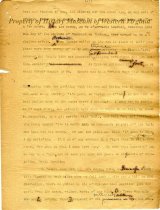
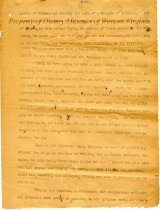
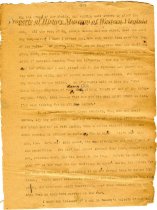
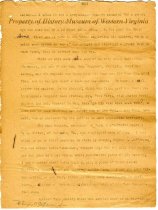
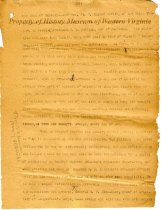
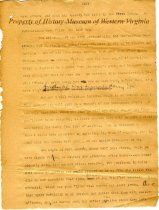
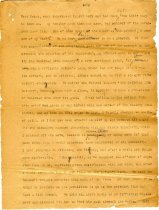
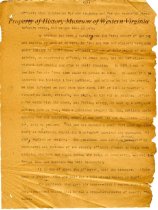
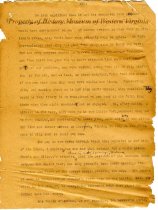
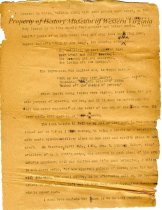
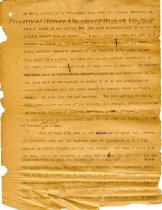
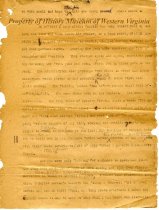
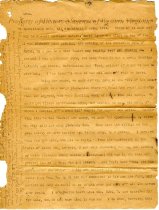
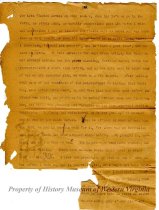
Eggleston's letter is fragile, the paper is aged, and the edges are beginning to break off. The type is also very light. The letter was used as a talk given to the A. P. Hill Camp of Confederate Veterans, January 3, 1895. Eggleston's opening remarks mention that the current generation shows little interest in the events that occurred between 1861-1865. They are neglecting to preserve the history for future generations. But their children will appreciate the efforts of George S. Bernard in saving some of the material of those heroic days. Eggleston's paper is his effort to give recollections of his service in the artillery, and of the mortar service in the siege of Petersburg. In the next few paragraphs he tells of going to a store as a stranger, and listening while six loafers sitting around a stove tell tales of their exploits and heroism. How Stuart or Fitz Lee confided their plans, or how they listened to their advice. Or of how they fired the critical shot that turned the tide of battle, and of their coolness and daring. Eggleston listened to their tall tales and finally told them that he was the greatest hero and commenced to tell them of his experiences in the 44th Virginia from Rich Mountain to Appomattox. Silence followed his talk, while the lay-abouts found other places to which to scatter. Eggleston then begins his story. He was transferred to Lamkin's battery in August 1861. The battery had seen unattached service in South Carolina for two years, as had been stated by Myers, of the battalion, in his chapter of "War Talks of Confederate Veterans". The battery had been assigned to Haskell's battalion of Longstreet's corps, upon its return to Virginia in November, 1863. When the battery arrived at Orange Court House, the equipment they were supposed to receive had been given to the Washington Artillery. Other guns were furnished, but no horses. When the Wilderness Campaign started, Lamkin volunteered to have his men armed with muskets and serve as support between the guns of the other batteries of the battalion. Haskell, who commanded the battalion, was from South Carolina. The four batteries of the battalion were composed of one battery from South Carolina, two from North Carolina, and Eggleston's from Virginia. As mentioned, his battery served as support and used Enfield rifles, from the Wilderness to Petersburg. Upon reaching Petersburg, the Confederate Government needed Coehorn mortars, but had no bronze with which to make them. Lamkin volunteered to try iron ones, and these were cast for the use of Eggleston's battery. There were to be eight Coehorn or 24 pounders, one eight-inch or 64 pounder, and two portable 12 pounders for short range. Lamkin devised a plan on how they could drop shells, night or day, on any point where the range was obtained, without seeing the object. The next portion of the letter refers to the Petersburg lines and the activities at the Crater. Besides the eleven mortars in Lamkin's Battery there were two more in Walker's, a distance to the right of Eggleston. Six of Lamkin's were in the Jerusalem Plank Road at intervals from the Gee House to the place where the covered-way crosses the road near the present-day Jewish Cemetery. The redoubts east of the road were unfinished and unoccupied, except for a short time in the morning, by a part of Elliot's brigade. The eight-inch mortar was placed in the pines, north of the covered-way and in the rear of Wright's battery. Just east of Blanford Cemetery was a small earthwork of two pits called "Fort Lamkin". It was under the command of Eggleston's brother, Sergeant-Major George C. Eggleston. Eggleston, himself, was sergeant of the two mortars. Sergeants are not left in command of forts, but on the evening of 29 July his brother George was called elsewhere, and Eggleston and another sergeant (Coffey) were left to share responsibility. On the morning of the 30th, Eggleston was made aware that a mine explosion had occurred at the salient occupied by Pegram's Petersburg battery and Elliott's South Carolina brigade, and that fighting was going on inside the lines at that point. As it was useless to fire on a moving target, it was determined to fire the mortars at the range set opposite the salient. Eggleston says he opened fire and kept it up until the supply of shells was exhausted. They then sent the remaining powder and fuses to the main battery. All Eggleston and Coffey could do was observe the battle. The enemy were in possession of the line, and fighting was desperate, but at last they heard that Mahone's brigade was marching through the covered way. Eggleston says the cannonade was so furious that the sound merged into one continuous roar, and it seemed a long time before the first charge occurred. The Virginians charged at the most critical time and carried the works with fearful loss, almost to the Crater itself. Wright's Georgians, and Sanders' Alabamians made other charges. Eggleston has always been amazed that Mahone's men never realized the grandeur of their conduct on that field. They not only made the charge under fire but formed their line and charged under the heaviest cannonade man had made on land, Gettysburg excepted. They also charged two hundred yards at a ten-foot ditch packed with infantry, and carried it. Why they were not exterminated is probably due to the fact that Confederate artillery and mortars had given the enemy a hard time of it and the enemy were somewhat demoralized. Mahone's charge was magnificent for there is no doubt the enemy should have taken Petersburg. There is evidence that the Federals were ordered to advance and were leaping over the edge of the Crater and out of the ditch to the north of it when they saw the advancing line. The men of the artillery wondered why the enemy did not advance earlier. Eggleston later found out that the troops first in the works were told to take the works and hold them while another line of troops were to be sent forward and take the next line (the covered-way). The Federals reasoned that because they, themselves, would never consider it, that Lee would not attempt to hold Petersburg with a single line, either. The Federals misjudged Lee's daring. Lamkin fired from the six mortars on the Jerusalem Road into the Crater and the enemy works beyond, all day. Lee and Beauregard made their headquarters in the Gee House. Lee ordered Lamkin to man the two field-pieces left in the road that were unmanned for some reason. Sergeant Coffey ordered out two detachments for this artillery assignment and within a few minutes they were hitting the crest of the Crater with canister, and raking the adjoining works with shrapnel. These two, Flanner's six, Wright's four and Davidson's one, prevented the Federals in the Crater from looking over toward the Confederate lines. After the first charge by Mahone's old brigade (now Weisiger's), Eggleston's's two twelve-pound mortars were carried up the recaptured ditch, and fired from among the infantry, into the Crater. The shells could be plainly seen, as they were slow in flight, which must have added to the demoralization of the enemy. Lamkin's services that day attracted the attention of General Lee and were the cause of large numbers of men from disbanded batteries, as well as conscripts, being added to the battery to increase it to a battalion of mortars. Eggleston praises Brigadier General Elliott of South Carolina, whom he new well from the Beaufort Artillery. Elliott held Fort Sumpter for almost a year after it was declared untenable. At the Crater, his brigade was partly blown away by the mine explosion, and broke. It was thought by many that there were three mines being dug and more explosion was expected. Elliott tried to rally his men but was shot through the lung and taken from the field. Colonel McMaster did rally the men and reoccupied much of the works, forming a line in the unfinished redoubts in front of the Jerusalem road. Ransom was on his left, and he helped McMaster gain ground up the trenches. Wright's, Martin's, Flanner's, Davidson's, Walker's guns and Wise's brigade did all they could before the arrival of Mahone. Eggleston concluded his recollection of the Crater and went on to reflect on Cold Harbor. His battery were acting as support between the guns of Captain Garden, occupying ditches cut from gun to gun. On one particular day, when only sharp-shooting was going on, Eggleston walked along the lines to see a friend, some 300 yards away, who was in the 22nd South Carolina. Coming to a swampy place he was told to trot across, as the enemy could see anyone passing there. After complying with their request and arriving among the South Carolinian he was asked who was the artillery officer in the black overcoat who had come just ahead of him. Eggleston replied that it was Captain Garden. He was told that when Garden crossed that swampy area he did not hurry across and they witnessed dust fly off his sleeve. Garden did not indicate that he was hit, but once behind the South Carolina works he told them he was wounded. He told them he made no sign of being hit so that the Federal marksman would not know the exact range and elevation. This way the next man had a chance of not being hit. The day before, one of Garden's men had been wounded by shrapnel, and when the litter bearers started to the rear a shell burst close by. This caused one of the bearers nearly to spill the man on the stretcher. Garden saw this, and said that if the man did that again, he would come and slap his jaw. Eggleston then talks about Spotsylvania Court House. About 300 yards in front of his position was an old chimney and an old outhouse. For a day, two enemy sharpshooters from that location had been picking off some of the men. A sergeant from Flanner's battery exposed himself so the shooter's location could be determined. They were behind the chimney. The sergeant then went back to his gun and, taking his time to aim, fired. He intended to hit the chimney about four feet from the top. His comrades cheered and the firing from the chimney stopped. The next day, when the enemy skirmish line was pushed back, Eggleston went by the chimney and saw four dead men under the bricks. When Eggleston was asked about the bravest act he ever saw, he offered the story of Lieutenant Muldrow of Garden's battery. The battery was in a duel with a Federal battalion some nine hundred yards away. Garden's guns were mounted enbarbette, meaning that each piece was on solid ground with a semicircular ditch cut around in front of it. The dirt was thrown forward for a parapet, which was nearly as high as the muzzle of the gun, which was free to fire in any direction over the top. The men standing in the ditch were in relative safety, but the lieutenant in command was exposed. The lieutenant wanted his gun to fire exactly as the enemy's shell burst. This was so the enemy did not see the puff of smoke coming from his gun and did not know when it was fired, and also so that his own men were not intimidated. But the man who pulled the lanyard would crouch down and wait until the enemy's shell had burst before pulling the lanyard to fire. The lieutenant was not satisfied and he told the men if they did not do as directed he would move the gun and the men in front of the works and fight it out without protection. He stood to the side of the gun fully exposed. He watched for the puff of smoke from the enemy and gave the command "Ready". The enemy shell burst so close that it burnt his hair, but he gave the command "Fire". Eggleston relates another story. Leaving Petersburg on the 29th of September, the battery was getting ready for the assault on the 30th against Fort Harrison, north of the James River. Lieutenant Massie was in command. Massie's battery had received new recruits that brought it up to 210 men, and it probably was the largest company in the army, manning 26 mortars. There was no sharp-shooting going on, and things were rather monotonous. Massie was the kindest of men, and allowed a leave of absence to all who asked. Some, for a day or two, and some, only for a few hours. When the enemy received word of the capture of Savannah by Sherman, they fired off a salute. When Massie called the men to stand to their guns, there were only enough to man three mortars. Massie would help work one gun, and then go on to another. When the enemy fort fell silent Massie was in a rage. His anger was with himself for letting so many of his men go on leave of absence. At the battle of Pocotaligo, South Carolina in 1862 Eggleston says they fell back and pulled up a bridge just 225 yards from the enemy, and had no works for protection. Their force was two batteries of artillery, two companies of dismounted cavalry, and part of a company of infantry. The enemy had six regiment of infantry, two of cavalry and twelve pieces of artillery. Out-manned, the Confederates had to hold that bridge until reinforced, because, once it was crossed, the road then gained would force the loss of Charleston and Savannah. That afternoon the command was badly broken but Eggleston remembers seeing Massie. He was in command of the two guns with a few men left, and stood with a sponge staff in his hand. He sponged and rammed the gun himself. He would encourage his men by calling out "Boys, remember the state you came from and the girls you left behind you!" As this was the only Virginia company in South Carolina, his words had great effect. Now and then, he would aim the gun and hit an enemy piece, which brought cheers. Later in the afternoon the then-Captain Elliot ordered him to the rear, because he was wounded. Eggleston then takes us back to Petersburg. When in the trenches, the officers and sergeants took turns standing in the infantry works and observing the drop of the artillery shells, sending back orders to alter the fuses and to give the ranges for future use. Everyone but Massie and one other would use the sandbag loopholes to observe, but Massie and the one other put their heads up and looked over the top. One day he [Massie?] received a ball that hit him in the forehead and plowed over the scalp knocking him senseless. The bystanders thought him killed, but he survived. In Eggleston's detachment were the three brothers, Sam, Gus and Oscar Bowles. One day as they sat under the shelter at Fort Lamkin a bullet came through. Gus said he was hit, but Oscar also said he was hit. The ball had hit them both. Gus was hit in the hand, where it passed through and traveled over to hit Oscar in the leg. Gus insisted that Oscar give him the bullet after it was cut out as it hit him first. Oscar said no, because it rested in him. They continued to quarrel over the bullet as they were carried to the rear. A man in Ramsey's battery was wounded and the men in the battalion reminded him that he could claim that his eye was shot out by a 12-pound solid shot. It happened near the South Anna River when a solid shot struck the top of the parapet, dislodging a piece of gravel which took out his eye. Once, one of our men, Campbell, was lying under a flytent, asleep. The Captain was lying with his head not far from Campbell's feet, but not under the tent or asleep. The sound of a ball was heard. Everyone there thought the ball hit a canteen lying near the Captain's head. Campbell came out of the fly-tent with strong words against the man, whoever it was, who had hit him with a rock. He had actually been hit in the foot by the ball. The foot was so shattered that it had to be amputated. Eggleston would sometimes visit his cousin in the Otey Battery. One day when within one hundred yards a mortar shell burst high in the air, and a piece struck a man in the battery, in the face. All thought him killed as he was carried to the rear, but he lived and became a citizen of Richmond, even though one side of his face was torn away. Also, while in Petersburg, the battery commanded by First-Lieutenant Pulliam. It was positioned near Fort Lamkin on a hill behind Wright's battery, with a commanding view. When things seemed relatively quiet, and the men were either mending clothes, writing letters, or enjoying a moment's rest, the battery in question would commence firing and stir up a fuss that affected everyone. Eggleston's brother went to see why this continued to happen, and see if he could resolve the problem. Upon arrival at the problematic battery, Eggleston's brother found his old college friend, Pulliam. Asked why he was always firing his guns at times when not required, Pulliam gave his answer. He was told to requisition his ammunition from General Bushrod Johnson's ordnance department, which he did. Then he was notified to get such supplies from General Anderson's ordnance officer. So following orders he did as directed. Then before any ammunition arrived, General Alexander, chief of Artillery of Longstreet's Corps, told him that previous ammunition orders were in error and that he should get his supplies from First Corps. He therefore made a third requisition. Having one of his guns knocked out, Pulliam became nervous about having an oversupply of ammunition. He asked General Alexander what he should do. He received the following answer "Shoot at every thing you see an inch high, a foot long, or a year old." So that was what he was doing. Eggleston then tells the reader that he will relate an unbelievable story that he insists is not made up. One night while at Fort Lamkin and while firing to attract the attention of the enemy, two gentlemen in white-duck (strong linen or cotton) suits of jackets and pants stepped up from the little ravine in the rear. One of the men spoke to Eggleston's brother and said they were cavalry officers, and had not seen mortar practice since leaving West Point. They had come out from their camp to look on. Neither gave his name, but referred to his companion as "Colonel, a member of my staff." So the thought was that the other one was a general. Eggleston was ordered to fire on the railroad iron battery. Not a pleasant target as the enemy had the range with its mortars and always opened up with a six-gun rifle battery alongside. It was called the iron battery because it appeared to have a protection of railroad iron over its guns. Eggleston used only one mortar and when it began to draw fire he changed to another point. The two strangers exposed themselves with little concern and after awhile the "general" asked who was in front on the infantry line. He was told "Ransom's Brigade", after which he asked if they could get permission to go to the skirmish line and look around. They were shown the path to take, and, as they left, they thanked the men of the battery for their kindness, and for the display they had given them. Eggleston and his brother made inquiries from then until the end of the war, but never found out the identity of the general and his colonel. After the war, Eggleston did not see his brother until 1871. His brother told him the following story. Sometime around 1867 his brother was a passenger on a steamboat that had left from Cairo, Illinois, headed for Memphis. He was sitting down and reading a newspaper when a gentleman asked for his name. He gave his name and the man asked if he had commanded a small fort at Petersburg that contained two mortars, and if he remembered the two men in white coats that visited. Eggleston brother well remembered. This man was one of the two officers and he was at that time a brigadier-general of cavalry from Maine. He and his companion were not spies or scouts, and they had left their camp to witness the mortar firing from their own lines. They had walked through their own lines walking from pit to pit talking with the men, until they realized they had walked their way into the Confederate lines. They had then walked to the rear of the Confederate lines, and worked their way to the front until reaching Eggleston's fort. From the fort they continued walking and talking to the men they met until they passed into their own lines and reached safety. Eggleston believes the two men had passed into the Confederate line by wandering through the gap between Wise's and Elliott's brigades. The man who talked to his brother was the general and he had recognized his voice. One Sunday afternoon two girls, dressed in white, came walking down the Jerusalem road, among the men of the battery, opposite the crater. Every hundred yards or so they would stop and sing the poem "Song of the Camp". These young ladies risked their lives in order to cheer the men. It can be seen why the men of the South showed such valor, because their women were cast from the same mold. One of the last battles Eggleston remembers was between artillery and cavalry. On April 8, 1865, General Walker, of Hill's Corps, had been ordered to push ahead to Lynchburg with the 150 guns belonging to all three Corps. The purpose was to save the guns for Gen. Joseph E. Johnston, but then Walker got orders to go into camp near Appomattox Station. Eggleston then explains that, as his new wife was at their home in Amelia County, he had gotten permission to ride over and see her for a short while, but just as he was about to return to his unit he heard firing. It was the raid that captured Ramsey's battery, and also the men and mortars in Ramsey's rear. Eggleston's brother had been sent to Amelia Court House to ask for permission to bring the mortars there, and thus he escaped being captured. The next day the two brothers and three others offered their services to the Richmond Howitzers. On the afternoon of April 8, between the Lynchburg road and the railroad west of Appomattox Court House, Eggleston was asleep. He was awakened by being rolled down the hill and being told the Yankees were charging them. To his right it seemed to be over, but a long line of cavalry were forming in the woods in front. The guns opened up with shell, and when the cavalry seemed about to charge the guns were loaded with canister. Eggleston could hear General Custer give the command to charge, and saw him lead the men forward. They charged multiple times, sometimes passing among the guns, but being driven out. The fighting lasted well after nightfall, with riderless horses galloping over the field, the cavalry charging, and the men working their guns. A line of infantry could be seen in the distance. The men were looking for the chance to spike and leave the guns as they could never hope to move them again. They were able to leave with 40 guns. All organization was lost and the men escaped as individuals. Eggleston and two others made their way on horseback to a small mountain toward the James River and slept on top. He was awakened the next morning by a man dressed in blue. He thought he was about to become a prisoner, though the man turned out to be from North Carolina, asking for information and food. They made their way down the mountain, riding through a large plantation where he was able to carry off some corn for himself and his horse. They made their way to Appomattox Court House where they had been told the army probably was located. Nearing the village they met some thirty cavalrymen riding away at a gallop. Riding along side a Lieutenant, Eggleston was told that General Lee had surrendered the army. He went on to say that General "Rooney" Lee had announced the same to his men, and that they should get away and take all the horses they could. Eggleston then realized that all he had left in the world was the horse he was riding, the clothes he was wearing and his wife at home. To save the horses he felt they would have to cross the James River. So they rode to the Bent Creek bridge, but General Sheridan had burnt it. They learned there was a place to ford the river some three miles upriver, if the river was low. A young lad volunteered to guide them and when they arrived at the spot it looked as though nothing had ever crossed. They plunged in and made for the other side. The horses were sometimes swimming and there were immense rocks under the water, to climb over and slip on. Sadly, the rest of the page is damaged and the end of the story is not known. Also, there may be other missing pages. |
Year Range from |
1895 |
Creator |
Eggleston, Joseph W. |
Year Range to |
1895 |
Subjects |
Accent Accidents Address ( Oration ) African Americans Afro-Americans Ammunition Amputation Angels Artillery (Weaponry) Assault Basements Battalions Battery (military) Battle Battle flags Blankets Boat landings Boats Bombardment Books Breastworks Bricks Brides Bridges Brigadier General of Volunteers Bushes Camp Campaigns, Military Canister Cannoner Canteens (Beverage containers) Captain Careers Cavalry Charge [military] Cheer Chimney Civil engineering Civil War Civil war battles Clerk Coasts Colonel Comrades Confederate Army Confederate officers Confederate soldiers Confederate veterans Conscription, Military Corn Covered way Crest Detachment Dirt Displays Ditch Dueling Dust Earth-works (military) Elevations Enemy Escapes Events Evidence Explosions Eyes Face Flags Fleet Fords (Stream crossings) Forehead Forts & fortifications Gallop Gaps Generals Generation Girls Gravel Ground Gunboats Guns Hair Head Headquarters, Military Hills History Homes Honors Horses Howitzers Incident Infantry Inspector General Iron Jaw Judgment Knowledge Lanyard Laughter Leave-takings Leg Lieutenant Litter bearer Lungs Marksmanship Memory Mines (Warfare) Minie ball Mortars (Ordnance) Mountains Muskets Muzzle (gun) Negroes Newspapers Ordnance Outhouses Over-indulgence Overcoats Papers Parades & processions Parapets Pines Pits (Holes) Plantations Poems Powder Practice Pride Quarreling Question Raid Railroad Rally, (military) Ravines Recollection Redoubt (military) Reserve Resignation (from the army) Retreats, Military Road cuts Roads Sabre Salient Salute Scalps Scouts & guides Scouts, Military Security Sergeant Service (military) Sharpshooters Sharpshooting Shells (Ammunition) Shelters Shrapnel Siege Silence Skirmishers Sleeping Sleeve (clothing) Smoke Speech Spies Sponges Steamer Store Stories Stoves Suits (Clothing) Sun Supplies Tents Transfers Trees Trench Troops Uniforms Views Villages Visits Wagon trains War Wheels Woods Wounds & injuries Yankees |
Search Terms |
44th Virginia Infantry A. P. Hill Camp of Confederate Veterans Alabama Brigade Amelia County, Virginia Amelia Court House, Virginia Amherst County, Virginia Appomattox Court House, Virginia Appomattox Station Battle of Chancellorsville Battle of Crampton's Gap Battle of the Crater Battle of the Wilderness Baxter Road Beaufort Artillery Bent Creek Blandford Cemetery Cairo, Illinois Charleston, South Carolina Civil War Coehorn (mortar) Cold Harbor Confederacy, the Confederate Army Confederate government Confederate Veterans Coosaw River Crater (Petersburg) Davidson's Battery (Artillery) Elliott's Brigade Enfield (rifle) Fort Harrison Fort Lamkin Fort Sumter, [South Carolina] Forty-Fourth Virginia Infantry Gee House Georgia Brigade German Artillery of Charleston,SC Gettysburg, Pennsylvania Hampden-Sydney, Virginia Haskell's Battalion James River Jerusalem Plank Road, Petersburg, Virginia Jewish Cemetery Longstreet's Corps Lynchburg, Virginia Mahone's Brigade Maine Memphis, Tennessee North Carolina Orange Court House, VA Otey's Battery (artillery) Petersburg, Virginia Pocotaligo, South Carolina Ramsey's Battery Rich Mountain Richmond Howitzers Richmond, Virginia Savannah, Georgia Second Battle of Bull Run [Manassas] Second Battle of Manassas [Bull Run] Seven Days' Battles South Anna River South Carolina Spotsylvania C. H., [Virginia] Union Theological Seminary, Virginia Virginia War Between the States War Talks of Confederate Veterans Washington Artillery West Point Military Academy Wilderness, The Wise's Brigade Wright's Battery [artillery] |
People |
Alexander, Edward Porter Anderson, Richard H. Beauregard, [Pierre Gustave Toutant] Bernard, Geo. S. Bernard, George S. Bowles, Augustes C. (Gus) Bowles, Oscar N. Bowles, Samuel G. Coffey, John Davidson, George Eggeston, George Cary Eggleston, Jos. W. Eggleston, Joseph W. Elliott, [Stephen Jr.] Flanner, Henry G. Garden, Hugh R. Haskell, John C. Hinton, Drewry A. Hooker, Joseph (General) Jefferson, Eugene C. Johnson, B. [Bushrod] R. Johnston, Joseph E. Lamkin, James N. Lee, Fitzhugh Lee, Robert Edward Lee, William Henry Fitzhugh (Rooney) Longstreet, James Mahone, William Martin, S. Taylor Martin, Stephen Taylor Massie, Fletcher T. McMaster, [Fitz William] Muldrow, James M. Myers, Daniel Otey, George Gaston Pegram, R. [Richard] G. Pope, John (General) Pulliam, Sam'l. H. Ramey, [unknown] Ransom, Matt Whitaker Sanders, [John Caldwell Calhoun] Sheridan, Philip H., General Spencer, Charles A. Stuart, James Ewell Brown (J.E.B.) Walker, David Norvel Walker, Reuben Lindsey Weisiger, David A. Wilkenson, John P. Wise, Henry Alexander Wright, Ambrose Ransom "Rans" Wright, Samuel Taylor Wright, Samuel Taylor |
Event |
Civil War |
Collection |
George S. Bernard Collection |
Imagefile |
025\200975157.JPG |
Number of images |
30 |
Object Name |
Letter |
Object ID |
2009.75.157 |
Extent of Description |
30 pages, size 5" x 8" |