

Archive Record
Images
Additional Images [2]
Metadata
Title |
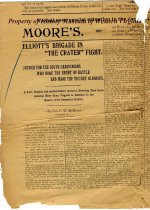
Newspaper article on Elliott's Brigade at the Crater |
Dates of Creation |
March 5, 1899 |
Scope & Content |
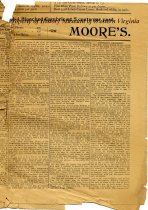
This newspaper article takes up two full pages with the first part on the front page, continuing on the reverse. The paper is deteriorating, which has resulted in some empty spaces. Four images make up the front page and four images the reverse. The first two images are advertisements and have no connection to the story. The story of Elliott's Brigade begins at the bottom half of the front page and continues on the whole of the reverse side. The article, written by Col. Fitz W. McMaster, is intended to glorify the fighting done by the South Carolinians at the Battle of the Crater at Petersburg on July 30, 1864. McMaster feels that South Carolina deserves more credit for its sacrifices at the crater. Background and the Battle of the Crater. Elliott's Brigade consisted of the 17th,18th, 22nd, 23rd, and 26th South Carolina Infantry, under the department commanded by Gen. P.G.T. Beauregard. The division commander, Maj. Gen. Bushrod Johnson, had positioned Elliott's Brigade in the breastworks supporting Pegram's artillery. These breastworks, consisting of ditches with a raised earthen parapet, were fronted with sharpened tree branches. Also involved were enclosed redans or forts used as strong points for infantry and artillery such as Pegram's redoubt (an arrow-shaped embankment) called a salient. At the salient, additional trenches were dug parallel to the zigzagging communication trenches. This labyrinth was linked to the rear with sunken roads (called covered ways) along which men, guns and wagons could move, undercover from enemy guns. Cut within the trenches were sleeping holes and alley ways. To the rear of these positions lay a depression or swale that led to the Jerusalem Plank Road and Cemetery Hill. The hill dominated the surrounding territory and would become the objective of the Federals. As the Federals reached the Confederate defenses, they too dug fortifications. The unit directly across from the salient, which lay 130 yards away, was the 48th Pennsylvania. It was this unit that would execute the plan to dig a mine shaft to reach the salient and blow it up. With little or no assistance from his seniors, who showed little interest in the undertaking, Lt. Col. Henry Pleasants, a civil engineer and commander of the 48th Pennsylvania, commenced digging a mine the 25th of June, 1864. The shaft measured 586 feet in length, and 5 feet in height. It had two lateral galleries that extended 40 feet left and right at the end of the shaft that extended under the salient and was completed the 23rd of July. It took four extra days to load the 320 kegs of black powder within the galleries. The kegs were concentrated in eight magazines, each containing 1,000 pounds of powder. The magazines would be detonated by gunpowder-filled troughs leading from the main gallery, where a 98 foot fuse ran toward the mine entrance. The original plan, drawn up by General Burnside, was to advance General Ferrero's division of Negro troops into the gap of the exploded Confederate line, some fanning to the right and some to the left down the line of the enemy's works as rapidly as possible. Those remaining, along with following divisions, were to move to the crest in front and continue on, to take Cemetery Hill. Ferrero drilled his troops in their assignments only to be informed on the day before the explosion that his Negro division would not be used. General Meade objected to using Ferrero's men, with Grant approving, as it would appear that the army were "shoving these people ahead to get killed because we did not care anything about them. But that could not be said if we put white troops in front." Instead the attack fell on the lead division of Brigadier Gen. James Ledlie, a known weakling, drinker, and coward. At 4:40 A. M. a cloud of earth blew skyward one hundred feet in the air, creating a hole 130 feet long, 97 feet wide, and 30 feet deep. At this juncture Federal artillery fired into the Confederate lines. Elliott's salient was obliterated as 22 gunners of Pegram's Battery along with 278 men of the 18th and 22nd South Carolina were blown to bits. Others were injured as they fell back to earth along with the dirt and debris. Some were buried up to their necks, and some with just their leg or foot sticking out from the earth. With orders to gain the crest of Cemetery Hill, the Federals moved forward, crossing the 130 yards of open space only to stop at the crater's rim, mesmerized by its size. This forced those behind to come to a halt and mill around, thus causing them to be exposed to Confederate artillery fire. Jumping, sliding and tumbling into the crater, regimental units intermingled and brigade cohesion dissolved. As the sun rose, brigade followed brigade into the crater and up the other side as they climbed, attempting to re-form on the opposite side of the crest. Had the original plan been executed, in which regiments were to sweep down the Confederate lines on the right and left from inside the crater, what followed might never have occurred. Survivors of Elliott's Brigade continued to occupy the trenches and traverses that had been cut by the explosion. The survivors, now recovered, were in a position to do great damage to the Federals by firing on those re-forming on the Confederate side of the crest, and those entering the same trenches and traverses. McMaster, who had taken over command from the wounded Elliot noted the use of the bayonet in close quarters. He also had organized a thin line across the throat of the blasted salient in the retrenchment, 200 yards to the rear. He posted a second line in a ravine 100 yards to the west. The Confederates had now positioned artillery to sweep the crest of the crater with canister shot. Also in use were two of Major Haskell's coehorn mortars; these portable mortars were equipped with four handles and weighed 300 pounds. Each was carried and put in position by four men. Each could loft an 18-pound shell over the parapet and do terrible damage at close range. Conditions within the crater area were total confusion. No senior officer was on the scene to adjust to the situation, as General Ledlie had remained behind, safe within the union lines. Any attempt to go around the crater met with failure, and those seeking shelter wound up within the pit. Ferrero's black infantry, following those in front, had joined in the confusion. Three hours had passed since the explosion and all that the Federals had accomplished was cramming 10,000 troops into the crater. As Elliot's South Carolinians held the thin lines at and near the crater, General Lee ordered Gen. William Mahone to send two of his brigades north along the Jerusalem Plank Road. By taking the covered way they filed into the ravine held by McMaster, where they prepared to charge toward the crater. The Virginians arrived first, with the Georgia Brigade following behind. At the crater General Ferrero had passed forward orders for his black troops to take the crest of Cemetery Hill, so they formed up just beyond the lip of the Crater and proceeded to charge forward. Weisiger's Virginians jumped into action and the two infantry charges collided in the rifle pits and trenches west and north of the Crater. Outnumbered with no hope of reinforcements, the black troops broke and ran to the rear. The Confederates then realized they were fighting black troops, and they turned their frustrations onto their foe, driving through the traverse to within 20 yards of the crater itself. Hand to hand fighting with bayonets and rifle butts was common. At 10:00 A. M., Wright's Georgia Brigade came in behind the Virginians. Surrounded on three sides, any Federal soldier who attempted to return to his lines was cut down by bullets, or torn apart by the constant pounding of the Confederate guns.The Federals were giving up the fight. It was hot and there was no water. In the afternoon, Burnside ordered the withdrawal and told the commanders in the Crater to get out as best they could, but then the Confederates poured over the rim of the Crater. Every man who was shot, rolled down the steep sides to the bottom, and in places they were piled three and four deep. Between 2:00 and 3:00 P. M. it was over, and the Federals who survived, surrendered. General Lee reported to Richmond that the salient had been retaken and they had driven the enemy back to the Federal lines. Within hours the Confederates were digging new entrenchments in front of the crater. After the explosion, McMaster's South Carolinians, with fewer than 1,200 men, and with the help of two artillery batteries, resisted 9,000 of the enemy from 5:00 to 8:00 A. M. It was not until 9:30 A. M. that Mahone's 800 Virginians rushed the trenches, and it is for this reason McMaster believes that Elliott's Brigade deserved more credit. |
Year Range from |
1899 |
Creator |
McMaster, Fitz W. |
Year Range to |
1899 |
Subjects |
acreage African Americans Afro-Americans Artillery (Weaponry) Assailants Assault Attack Bank Banners Barbarians Barrel (gun) Barricades Baskets Battle Bayonets Black Americans Blouses Bombardment Books Breastworks Burials Burrow Butt Camp stool Cannons Carnage Casements Catacombs Cells (Rooms) Charge [military] Cheval-de-frise City Civil War Civil war battles Clay Coat tail Coats Coehorn (weapon) Coffee Colonel Column, [military] Confederate soldiers Confederate veterans Corn Counterscarp Court martial Courts martial & courts of inquiry Craters Crowds Crutches Debris Defeat Dens Deserts Dirt Dispatch Ditch Drills, Military Embankments Enemy Engineers Evacuations Explosions Face Famines Feasts Federal Feet Fire Flank Forts & fortifications Furlough Fusillade Game & game birds Gentlemen Glue Gorge line Graves Grenades Gulches Gunpowder Guns Hardship Hat Haversack Headache Headquarters, Military Heroes Honeycombs Honors Implements Infantry Investigations, Military Irishman Knee Landslides Language Lawyers Letters Lines (military) Man Masses Mines Mortars (Ordnance) Mounds (Landforms) Muskets Neck Negro Negroes Note Oil cloth Pain Paper Paragraphs Physicians Picket line Pipes (Smoking) Pits (Holes) Plank roads Postscript Prayer President Prisons Privet Proceeding Procession Provisions Quarters, Military Rain Ranks, military Ravines Record Regiments Reserve Retreat Scurvy Session Shells (Ammunition) Shelters Shoes Shot Shovels Shrapnel Sink (civil war toilet) Sketch Smoke Soldiers Songs Spades Spring State houses Sugar Sun Surrenders Swale Swans Sweat Swords Testimony Tin cups Traverses Trench Trench cavalier Troops Trophies Uniforms Veterans Victory Wagons Water White Wood planks Wooden legs Yankees |
Search Terms |
12th Virginia Infantry 13th Minnesota Infantry 17th South Carolina Infantry 18th South Carolina Infantry 22nd South Carolina Infantry 23rd South Carolina Infantry 25th North Carolina Infantry 26th North Carolina Infantry 26th South Carolina Infantry 49th North Carolina Infantry 61st North Carolina Infantry Alabama Appomattox Cemetery Hill [Petersburg, Virginia] Civil War Colquitt's Brigade Columbia, South Carolina Confederacy, the Confederate Army Confederate Veterans Eighteenth South Carolina Infantry Elliott's Brigade Elmira, New York Ethiopeans First Battle of Manassas [Bull Run] Fort Stedman Fort Sumter, [South Carolina] Forty-ninth North Carolina Infantry Georgia Greece Indiana Jerusalem Plank Road, Petersburg, Virginia Lexington, Kentucky Mahone's Brigade Massachusetts Michigan Ninth Army Corps Pegram's Battery (artillery) Petersburg, Virginia Ransom's Brigade Rome, [Italy] Seventeenth South Carolina Infantry Sixty-first North Carolina Infantry South Carolina Spotsylvania C. H., [Virginia] Thermopylae, [Greece] Thirteenth Minnesota Infantry Twelfth Virginia Infantry Twenty-fifth North Carolina Infantry Twenty-second South Carolina Infantry Twenty-sixth North Carolina Infantry Twenty-sixth South Carolina Infantry Twenty-third South Carolina Infantry Union Army Union Veterans Virginia War Between the States War of the Rebellion War Talks of Confederate Veterans West Point Military Academy Wise's Brigade Wright's Battery [artillery] |
People |
Adams, John (President) Bartlett, [William] Bates, Delevan Beauregard, [Pierre Gustave Toutant] Benbow, [Henry Laurens] Bernard, Geo. S. Bernard, George S. Bowley, [Freeman S.] Burley, [unknown] Burnside, [Ambrose E.] Caldwell, John Carr, [unknown] Cassons, [W. H.] Cherry, [Elijah H.] Clingman, [Thomas L.] Coit, [James Campbell] Colquitt, [Alfred H.] Crawford, E. A. Crowder, [unknown] Culp, [John Ripley] Davenport, [unknown] Davidson, [unknown] Dunlap, W. H. Dunovant, [William] Edwards, W. H. Elliott, [Stephen Jr.] Fant, [S. R.] Ferrero, [Edward] Fleming, David Fleming, [David George] Fleming, [John A.] Floyd, [Harrison D] Free, Joe Gibbes, Hampton Girardey, [Victor Jean Baptiste] Grant, [Ulysses S.] Griffin, [Simon Goodell] Handcock, [Winfield Scott] Harris, [unknown] Hartranft, [John Frederick] Haskell, John C. Heath, M. C. Hogan, J. S. Hoke [Robert F] Hoke, [A. D.] Hudson, J. H. Hunt, [Henry J.] Hutto, Starling Johnson, B. [Bushrod] R. Kershaw, [Joseph Brevard] Lake, George B. Lamotte, T. J. Ledlie, [James Hewett] Lee, Robert E. Lowry, Samuel Mahone, William McMaster, [Fitz William] Meade, George [Gordon] Moore, Cusack Morse, [unknown] Ord, [Edward Ortho Cresap] Paley, [William] Pegram, R. [Richard] G. Phillips, John Potter, [Robert Brown] Pratt, C. Quattlebaum, [Paul Jones] Ransome, [Matt Whitaker] Roman, [unknown] Russell, [David Allen] Sanders, Geo. [George] Clark Sanders, [John Caldwell Calhoun] Shedd, [James N.] Sims, [Clough] L. Sims, [unknown] Smith, Alexander R. Steele, [James F.] Stevenson, W. G. Thomas, [Henry G] Turner, [John Wesley] Venable, [Charles] Walker, D. N. Wallace, [William H.] Weisinger, [Davis] White, R. E. Whitner, [unknown] Willcox, Orlando Bolivar Williams, [unknown] Wise, Henry A. Wright, [S. T.] |
Event |
Civil War |
Collection |
George S. Bernard Collection |
Imagefile |
024\20097521.JPG |
Number of images |
8 |
Object Name |
Newspaper |
Object ID |
2009.75.021 |
Extent of Description |
2 newspaper pages, size 22 1/2" x 15 1/2" |