

Archive Record
Images
Metadata
Title |
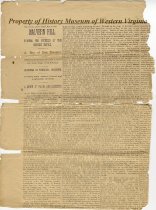
Fight at Malvern Hill - Article written by George S. Bernard |
Dates of Creation |
September 23, 1897 |
Scope & Content |
This article, printed in the September 26, 1887 issue of the Petersburg Index Appeal, was written by George S. Bernard on September 23, 1887. The newspaper is in pieces and some lines can not be read. The article is very detailed. Many paragraphs were taken from the reports of the officers (Northern and Southern) directly involved in the battle. To help summarize the article the names of the individuals who gave a report or relate their recollections will appear at the beginning of the paragraph. Bernard: Bernard begins by saying he was a member of General William Mahone's Brigade and carried his musket in many a battle, but the struggle at Malvern Hill stands out most in his memory. On July 1, 1862, Union Gen. George B. McClellen occupied the hill and plateau 14 miles below Richmond known as Malvern Hill. Confederate Gen. Robert E. Lee, having had much success for the preceding six days, was pushing forward and the federal army was determined to make a stand. General Lee: Jackson, pursuing down the Willis Church Road, found the enemy at Malvern Hill where he had concentrated his artillery, supported by masses of infantry, partially protected by earthworks. In front, the ground was open, sloping gradually from the crest and completely covered by his infantry and artillery. To reach the open ground, our troops had to advance through broken and thickly-wooded country. The whole was in range of the batteries on the heights and the gunboats in the river. General Wright: Confederate Gen. Ambrose R. Wright 's brigade of Georgians, and Mahone's brigade of Virginians, were assigned to open the engagement. General Wright explains in detail the terrain in his front, and where the enemy artillery and infantry were situated. Some of the enemy's heavy guns commanded the whole meadow in front of it, and could dispute any maneuvering of troops over any portion of the meadow. The number of guns from various batteries and positions could not have fallen short of 100. He estimated the Federal infantry to be 25,000 to 30,000. Large numbers of these were posted in the woods on the right and left, and the ditches across the meadows were lined with sharpshooters. General Magruder: Confederate Gen. John "Prince" Magruder directed the plan of attack. The hour growing late, he ordered Gen. Ambrose R. Wright's brigade, supported by Mahone, to advance and attack the enemy's batteries on the right; D. R. Jones' division, when it arrived, to advance on the right; Robert Ransom's brigade to attack on the left. His plan was to send in 15,000 men against the batteries and surprise the infantry. If unable to drive the enemy from his strong position, to continue the fight in front by pouring in fresh troops. Bernard: At four in the afternoon, Mahone's Brigade is halted while marching along the Willis Church Road in the direction of Malvern Hill. Just ahead is a dashing-looking officer (Magruder) and Mahone rides up for orders. A solid shot from a gun coming from the direction of the Crew house came bounding through the woods toward the lines of troops, which opened up to let it pass. Mahone's orders, along with Wright's, were to charge the enemy's batteries. The men in ranks thought the order was to charge the battery that fired the shot. The men move forward through the trees, and above their heads the cannon shot, coming from the Federal artillery, cut out the tops of the trees. The troops halted at a ravine, or gully. In the ravine was a brigade of troops sitting with their backs to the bank. The temporary halt was to determine the best route to take in order to go forward. The troops rushed up the slope of the hill toward the enemy, yelling at the top of their voices. They were allowed to get well up the hill when the enemy's infantry, not more than 200 yards distant in front, with their artillery in the rear, suddenly opened fire. The men were driven back with terrible loss, but rallied for another charge. The enemy's line was immovable and Bernard's 12th Virginia regiment being on the right of Mahone's Brigade, and Mahone's Brigade being on the extreme right did not get such severe fire as those to the left. Bernard could see, as he looked down the line of battle, a regiment or two would move forward, cheering; there would be a deafening roll of musketry, then all would be hidden from view by the smoke. The men receiving the fire would reel and fall, by the dozens. Then the line would fall back, rally, and return with another charge only to meet the same fate. General Lee: On the right the attack was made by Huger's and Magruder's commands. Several efforts were made to storm the hill at Crew's house. The brigades crossed the open field, raked by the fire of a hundred cannon and musketry from the infantry. Some gave way, others got to the guns, driving the infantry back, but were too weak to break the federal line, and sustained great loss. The firing continued until after 9 PM with nothing gained. Part were withdrawn; others remained in the open field. General Magruder: The fire of musketry and artillery raged; the battlefield was filled with smoke. Their artillery crashed through the woods and burst amid the artillery parked in the rear. The men cheered as they advanced, encouraged by the advance of Generals Wright and Mahone. The enemy being strong, brought in its reserves, compelling some of our men to fall back. Harrison, commander of the Charles City Troop, while leading his regiment, fell with seven wounds, near the enemy's batteries. General Wright: At 4:45 PM I was ordered by General Magruder to advance. No others were on the field, but I led the brigade, less than 1,000 men, forward against a superior force. Supported by Mahone, we pressed forward with brave men falling around me. I perceived a strong force of infantry sent forward on my left with the intent to cut off our support. I had the Third Georgia fire on the enemy, which, after three quarters of an hour, gave way. General Mahone: The brigade moved to the position assigned and was exposed to the enemy's sharpshooters posted behind wheat shocks. The order came from General Magruder that the charge assigned to General Wright and me should be made. It was now 5 PM. Our troops went forward over a succession of steep hills and ravines until coming up against the enemy's strong position behind the crest of hills covered by his guns. No other troops were engaged and for two hours the battle raged with destruction on both sides, but the men finally succeeded in driving the enemy from the heights in our front. We occupied the position from which he had resisted our advance. Colonel Edmonds: (Edmonds of the 38th Virginia of General Armistead's brigade). We held our position while under fire from canister, grape, and from occasional shells from the gunboats, until we saw Wright leading his brigade to our support. We sprang to our feet, certain of victory with such support. I gave the order to charge until we reached the musket-range of the enemy's supports to his artillery. Six times we attempted the charge and failed, and fell back under the cover of the brow of the hill. Major Cabell: (Cabell of the 38th) When Generals Wright and Mahone came up, the order was given to charge. After getting within seventy-five yards, the men were halted. They fired, after which we charged. Five times we charged, but were compelled to fall back. General McClellan: (USA) The attack was made upon our left and left center, with the brunt borne by Porter's Corps. So destructive was the fire from our artillery that no troops could have carried the position. Late in the evening, the enemy fell back, beaten and with terrible slaughter. General Couch: (USA) At about 4:30 PM, after a cannonade, the enemy pushed forward a large column from their right in the open field to carry Griffin's position. The fire from three batteries was concentrated on them. The attacking column kept coming on until within range of Griffin's Rifles, when it was stopped and formed line. General Porter: (USA) About six o'clock [Note: the hour is incorrect.] Magruder's corps opened with his artillery and pushed forward his columns of infantry. Sometimes whole brigades were thrown against our batteries, but our infantry and artillery dispersed them, some times driving them with the bayonet, capturing prisoners, and flags. Bernard: About sunset an advance is ordered and we move to the next hill seventy-five yards in our front. Colonel Weisiger, leading the charge, open fire upon the enemy from the new position . (Bernard then mentions an incident where an unknown elderly colonel urged the men to "Fire fast." "Give it to them." "They are nothing but damned Yankees.") With night coming on and the contending forces being so close, some men came close to being captured as it was difficult to tell friend from foe. General Wright. With night setting in it was difficult to tell friend from foe. Several of my command were killed by our own friends coming up on our left. Though it was extremely hazardous, I was determined to maintain our position. The fire was terrific; the shrieking of shells and the whizzing of bullets would make any man quail. My command was now reduced to less than 300, with about the same for Mahone's brigade, but we poured volley after volley into their ranks.The firing kept up until nine o'clock at night when it seemed to cease by consent. Soon after, the enemy could be seen moving with lanterns, looking after their dead and wounded. General Mahone: Darkness covered the scene, leaving General Wright and me with the remnants of our shattered brigades. As equals, we positioned all the various troops for the night, first establishing our picket line, then giving attention to our wounded. General Wright: Night came and the firing ceased except from a few of the enemy's guns. Mahone and I were left alone to dispute the possession of the field. We consulted and were determined to remain where we were, which was 100 yards from the enemy's batteries. If the foe should be left by morning, we would give battle again. Pickets were posted and the men slept. Detachments were sent to search for water and to administer to our wounded. Enemy lanterns could be seen while they moved their killed and wounded. Friend and foe mingled administering to the wants of the wounded. I wrote a dispatch to General Magruder informing him of our present condition and asking for relief. General Magruder: With the darkness I thought of withdrawing, but concluded to let the battle subside as we occupied the field, which was within 100 yards of the enemy guns. Pickets were posted by Wright and Mahone, whose brigades slept on the battlefield. Armistead and a portion of Ransom's brigade also occupied the battle-field. Bernard: With a slight rain falling, we held the position and lay on the ground on the slope of the hill. The cries of the wounded were audible all around, and with the ground being anything but comfortable, we slept. Even though we could hear the sounds of the enemy's retreat in the morning, they were still in position in our front. A few shots were fired by the pickets posted in our line. That there was a retreat and no assault was a godsend to us. General Trimble: The next morning I found the whole army in utmost disorder. Stragglers, ambulances, wagons, and artillery obstructing every road in a drenching rain presented a scene of woeful confusion. Bernard: When it became light, the part of the field that I could see was filled in all directions with the slain. The slaughter of the Confederates had been terrific. Gen. Jubal Early: The morning light gave an appalling sight as the field was strewn with the dead and wounded. The main body of the enemy had retired, but a body of his cavalry, supported by infantry was discovered on the field. To the right, near the top of a steep hill, could be seen a body of our own troops which proved to be General Wright's and Mahone's. Parties of our men were going to the front in search of the wounded. A demonstration by the cavalry was abandoned after a few shots fired by the Maryland regiment . Then parties from both armies gradually approached each other and continued their mournful work apparently appalled with the sight. General Mahone: Next morning a large body of the enemy's cavalry made their appearance on the line, at first indicating a descent on our ambulance corps and details on the field. The small body of troops remaining on the field and under my command were of my own brigade. With these, I continued to hold the ground with the view of protecting our details from the enemy's cavalry. Bernard: As soon as the enemy had retired, what remained of my brigade was marched back into the woods from which we started the afternoon before, and went into bivouac. Soon after, we were dismissed, after which several of us returned to the field of battle and strolled over it. There had been great slaughter on both sides, and where their line of battle formed could be seen a long line of strewn corpses of Federal soldiers. Bernard then concludes his narrative stating that in this sketch of the engagement he had endeavored, with the help of the official reports, to furnish a simple narrative of its leading and most striking features, while at the same time giving an account viewed from the standpoint of one of several thousand soldiers who took part in the tragic action. |
Year Range from |
1897 |
Creator |
Bernard, George S. |
Year Range to |
1897 |
Subjects |
Accoutrements Ambulance Corps Ammunition Arms (Anatomy) Artillery (Weaponry) Assault Attack Battery (military) Battle Battlefields Bayonets Bivouac Blankets Blood Bluffs Boats Bombproof Branch (stream) Bravery Bullet holes Bullets Caissons (Vehicles) Cannonballs Cannons Cavalry Chestnuts Civil War Civil war battles Colonel Colors Column, [military] Confederate officers Confederate soldiers Conflict Corpses Courier Crest Cries Daybreak Detachment Details Dilemma Disasters Disorder Dispatch Ditch Dwellings Earth-works (military) Editors Engagement Farm buildings Farmyards Federal Field Flags Flank Foe Friends Gauntlet Grape-shot Gunboats Guns Headquarters, Military Hills Horse artillery Horses Hostilities Incident Infantry Land Lanterns Limbs Line (military) Line of battle Meadows Minie ball Motion Muskets Muzzle (gun) Narrative Neck Oaks Orders, military Picket line Pickets Pictures Plans Plateau Prisoner Rain Rally, (military) Ranks, military Re-enforcements Recollection Records (Information) Redoubt (military) Regiments Reserve Retreats, Military Ridges Rivers Round-shot Sacrifices Sharpshooters Shells (Ammunition) Sketches Slaughter Smoke Soil Spectacles Staff Staff officer Stragglers Support Survivor Swamps Swords Timber Tragedies Trees Troops Trophies Valleys Victory Voice Volley Wagons Water Wheat Woods Work Writers Yankees |
Search Terms |
12th Virginia Infantry 3rd Georgia Infantry 5th Massachusett's Infantry Army of Northern Virginia Army of the Potomac Centry Magazine Charles City Troop Civil War Confederacy, the Confederate Army Confederate Infantry Confederate Veterans Crew's House Fifth Massachusett's Infantry Gaines Mill Griffin's Rifles Henrico County, Virginia James River Mahone's Brigade Malvern Hill Ransom's Brigade Rhode Island Artillery Richmond, Virginia Third Georgia Infantry Thirty-Eighth Virginia Infantry Turkey Bend Turkey Creek Twelfth Virginia Infantry Union Army War Between the States War Talks of Confederate Veterans White Oak Swamp Willis Church Road Wright's Brigade |
People |
Allen, George D. Armistead, Lewis Bryan, Henry Couch, Darius N. Cowles, Henry B. Early, Jubal Anderson Edmonds, Edward Claxton Griffin, Charles Harrison, Benjamin Hill, David Harvey Huger, Benjamin Hunt, [Henry J.] Jackson, Thomas Jonathan Jones David Rumph "Neighbox" Kingsbury, Henry Walter Kusserow, Charles Lee, Robert E., General Magruder, John Bankhead Mahone, William McClellan, George B., General Meagher, Thomas Francis Patterson, John R. Porter, Fitz John Ransom, Robert Sickles, Daniel Edger Trimble, Isaac R. Tyler, Robert Ogden Weisiger, David A. Wright, Ambrose Ransom "Rans" |
Event |
Civil War |
Collection |
George S. Bernard Collection |
Imagefile |
024\200975077.JPG |
Number of images |
4 |
Object Name |
Letter |
Object ID |
2009.75.077 |
Extent of Description |
4 pages, size 16" x 24" |