
Skip to content
Museum Homepage
Museum logo

Search Term Record

Metadata

Related Records

  1. Letter - November 13, 1836

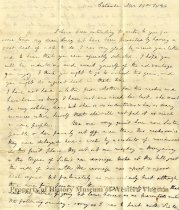
    Letter headed "Catawba, Nov. 13th 1836" from Emma Breckinridge to her sister, Lucy Gilmer, at Mr. Persico's Seminary in Richmond, Virginia. News of the family and neighbors -- the Gambles have left Grove Hill, the Watts children had whooping cough, and George Leyburn is going to China to be a missionary after he married Elizabeth Moseley.

    Record Type: Archive
    Letter
  2. Letter - November 25, 1836

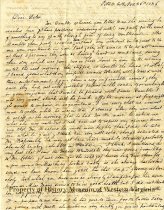
    Letter headed "Pitts. C. H. Nov. 25th 1836," from George Gilmer to his sister, Emma Breckinridge, in Fincastle. Tells of the Gamble's stopping with him on their way to Florida, and how much he likes James Gamble. Reference to the Cobbs [in Bedford], the Misses Randolph, Miss Moseley's marriage and moving to China, and to the unhappy ending of his romance [with Miss Moseley].

    Record Type: Archive
    Letter
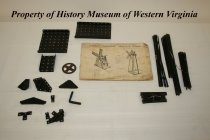
  3. Meccano Construction Set (Outfit No. 2) - Meccano construction set for Model No. 38, Small Windmill and Model No. 39, Windmill. Made with Meccano Outfit No. 2. 1908-1922, United Kingdom. The metal pieces and instructions to build the two models are included; however, it appears several pieces are missing from the set. Meccano is a model construction system comprising re-usable metal strips, plates, angle girders, wheels, axles and gears, with nuts and bolts to connect the pieces. It enables the building of working models and mechanical devices. Meccano was invented in 1901 in England by Frank Hornby and manufactured by the British company, Meccano Ltd, between 1908 and 1980. It is now manufactured in France and China. Currently sold "Erector Sets" are actually Meccano sets manufactured by Meccano S.N. of France, part of the Nikko Group of Japan. In 1901 Frank Hornby, a clerk from Liverpool, England, invented and patented a new toy called "Mechanics Made Easy" that was based on the principles of mechanical engineering. It was a model construction kit consisting of perforated metal strips, plates and girders, with wheels, pulleys, gears, shaft collars and axles for mechanisms and motion, and nuts and bolts to connect the pieces. The only tools required to assemble models were a screwdriver and wrenches. It was more than just a toy: it was educational, teaching basic mechanical principles like levers and gearing. The parts for Hornby's new construction kit were initially supplied by outside manufacturers, but as demand began to exceed supply, Hornby set up his own factory in Duke Street, Liverpool. As the construction kits gained in popularity they soon became known as Meccano and went on sale across the world. In September 1907, Hornby registered the Meccano trade mark, and in May 1908, he formed Meccano Ltd. To keep pace with demand, a new Meccano factory was built in Binns Road, Liverpool in 1914, which became Meccano Ltd's headquarters for the next 60 years. Hornby also established Meccano factories in France, Spain and Argentina. The word "Meccano" was thought to have been derived from the phrase "Make and Know". The first construction sets had parts that were rather crudely made: the metal strips and plates had a tinplate finish, were not rounded at the ends and were not very sturdy. But manufacturing methods were improving all the time and by 1907 the quality and appearance had improved considerably: the metal strips were now made of thicker steel with rounded ends and were nickel-plated, while the wheels and gears were machined from brass. The first sets under the new Meccano name were numbered 1 to 6.

    1987.111.028

    Record Type: Object

    Meccano Construction Set (Outfit No. 2)
  4. Roanoke World News - May 5, 1939

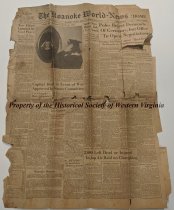
    Incomplete issue of the Roanoke World News, May 5, 1939. Only exterior pages. Cover includes a tribute to Jefferson High School seniors, news on progression of what would become WWII - attacks from Japan on China and advancement of Germans in Europe.

    Record Type: Archive
    Roanoke World News

Thank You!

Confirmation Message Here....