Skip to content
Museum Homepage
Museum logo

Search Term Record

Metadata

Related Records

  1. At home card for Josephine Gale and Allen Palmer - n.d.

    An 'At Home' card for Josephine Gale and Allen Ingles Palmer, included with the invitation. After the wedding, the couple resided in New York City.

    Record Type: Archive
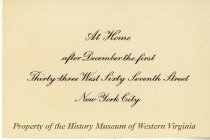
    At home card for Josephine Gale and Allen Palmer
  2. 'At Home' card for Josephine Gale and Allen Palmer - n.d.

    An 'At Home' card for Josephine Gale and Allen Ingles Palmer, included with the invitation. After the wedding, the couple resided in New York City.

    Record Type: Archive
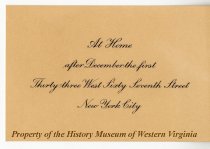
    'At Home' card for Josephine Gale and Allen Palmer
  3. Captain John Griffin in Dinwiddie County - 1894

    This letter by Capt. John C. Griffin is about life in Dinwiddie County in the vicinity of the opposing armies during the last years of the war. The 37 pages are typewritten and on the first two pages are glued a brief biography of Griffin. The line stating his date and place of birth are unreadable, but the next line refers to Virginia. The family moved to North Carolina where Griffin was educated. He attended Hampden Sydney College in Virginia, ...

    Record Type: Archive
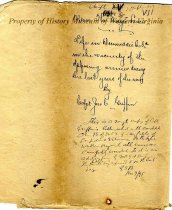
    Griffin Page 1
  4. Engraving plate for the 'At Home' card included with the wedding invitation for Josephine Gale and Allen Palmer - n.d.

    Engraving plate for the 'At Home' card included with the wedding invitation of Josephine Gale and Allen Ingles Palmer. The plate is sealed inside a double sided print on cardstock of the invitation with a strong olive green paper tape. On the verso, a large 'x' has been marked through the invitation. After the wedding, the couple resided at 23 W 67th St, New York City.

    Record Type: Archive
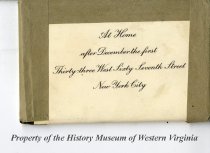
    Engraving plate for the 'At Home' card included with the wedding invitation for Josephine Gale and Allen Palmer
  5. Letter - December 28, 1835

    Letter headed Leigh, December 28, 1835, from Mary Gilmer to her mother, Mrs. Mary Fitch, in Fitchville, a village of Bozrah, Connecticut. Tells of her trip home, news of the family, Emma's little girl sick with measles, Harmer and George are doing well in their professions; tells of Mrs. Burwell's sudden death six weeks after her daughter had died with the measles; messages to family and friends in Connecticut; mentions the dreadful fire in New Y...

    Record Type: Archive
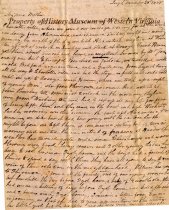
    letter
  6. Letter - March 10, 1836

    Letter with heading "Leigh, March 10, 1836," from Mary Gilmer to her daughter, Emma Breckinridge, at Catawba, giving full account of Harmer's wedding, news of John's fine progress at school. Urges Emma to visit before summer, and attend a church convention to hear Mr. Cobbs (who has now gone to Richmond). Says Mr. Gilmer's spirits are low, but all the family gathers to hear the letters they have received read aloud.

    Record Type: Archive
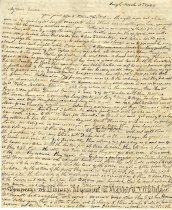
    letter
  7. Letter - November 25, 1844

    Letter headed "Catawba, November 25, 1844" from Emma Gilmer Breckinridge to her sister Lucy Gilmer at Leigh, near Hardin's Tavern, Albemarle, Virginia, responding to her last letter and giving a lot of news about family and friends, tells of plans to move from Catawba to Grove Hill and inviting all the family to gather there for Christmas, today is her wedding anniversary, new plans for their driveway at Grove Hill, of a little girl who has lost ...

    Record Type: Archive
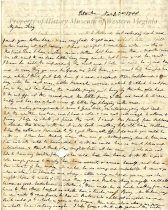
    Letter, page 1
  8. Letter of May 11, 1846 from Emma Gilmer Breckinridge to Mary Gilmer - May 11, 1846

    Letter headed "May 11th 1846" from Emma Gilmer Breckinridge at Fincastle to her mother, Mary Gilmer, at Leigh, near Hardins Tavern, Albemarle, telling of local news, reports on the weather, crops, family news, and social comments of many visitors, plans for a strawberry festival, encouraging her mother to visit more often, and other family news.

    Record Type: Archive
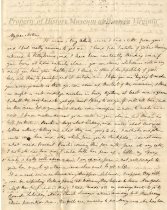
    Letter, page 1
  9. 2014.13.3
  10. Statue of Liberty postcard adressed to Peggy Robertson - May 1947

    The front of the Postcard has a picture of the Statue of Liberty on it. On the back The stamps on the postcard indicates it is from New York City. There is also a green U.S postal stamp with George Washington on it. On the back, near the vertical edge of the postcard it has a location named 118 East 28th street, New York City. There is a stamp that states Feburary 22nd 6:30 PM, 1947.

    Record Type: Archive
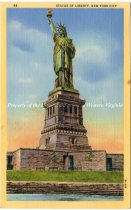
    Statue of Liberty postcard adressed to Peggy Robertson
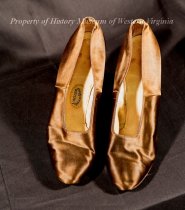
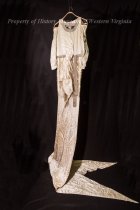
  11. 2014.13.1 - dress in entirety
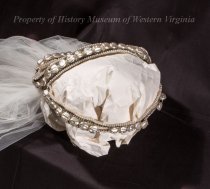
  12. 2014.13.2-1
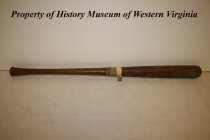
  13. Wooden "Louisville Slugger" signature bat with signature of Lou Gehrig. - Wooden "Louisville Slugger" signature bat with the signature of Lou Gehrig etched on the bat. 20th century, American. The following is etched into the bat: "LOUISVILLE SLUGGER, 40-L.G., HILLERICH & BRADSBY CO, MADE IN U.S.A., LOUISVILLE, KY., TRADEMARK REG...PAT OFF." In addition, the following is etched into the wood of the bat: TRADEMARK, Lou Gehrig (Lou Gehrig's signature), REG. U.S. PAT. OFF." J. Frederick Hillerich emigrated with his family from Baden-Baden, Germany to the United States in 1842. The Hillerichs moved to Louisville, Kentucky where J. Fred started a woodworking shop in 1856. By 1864 "J.F. Hillerich, Job Turning" was in operation and filled orders for businesses by custom-turning everything from balusters to bedposts. His eldest son, John Andrew "Bud" Hillerich, was born in Louisville in 1866. The firm thrived and by 1875 the little woodworking shop employed about 20 people. In 1880 Bud Hillerich, who was an amateur baseball player, became an apprentice in his father's shop. Young Bud made his own baseball bats along with bats for several of his teammates. There is debate over the origins of the company's first bat for a professional player, but Bud played a key role in getting his father's business involved with what would become the company's signature item. According to company legend, the first pro bat was turned by Bud for Pete Browning in 1884. Browning was a star on Louisville's professional American Association team - the Eclipse. On a spring afternoon Bud, then seventeen, witnessed Browning break his favorite bat. Bud offered to make a bat for his hero and Browning accepted. According to the story, after the young wood shop apprentice lathed a quality stick from white ash Browning got three hits with it in the next game. One of Browning's nicknames was, "The Louisville Slugger." Bud Hillerich continued to improve the manufacturing processes of the new bat business, inventing a centering device for a lathe and an automatic sander. Their baseball bat business grew. The bat was first known as the Falls City Slugger, (a reference to Louisville's location at the Falls of the Ohio River), but the brand name was changed to Louisville Slugger and registered as a trademark in 1894. Bud Hillerich became a partner with his father in 1897 and the name of the firm was changed to J.F. Hillerich and Son. The success of the growing bat company was further enhanced in 1905 when Honus "The Flying Dutchman" Wagner, a star for the Pittsburgh Pirates, signed a contract as the first player ever to endorse a bat. His autograph was also the first to be used on a bat and the first time a professional athlete endorsed an athletic product. A fire severely damaged the bat factory in 1910 but rebuilding began quickly. In 1911, Frank Bradsby, a successful salesman for one of Hillerich's largest buyers, joined J.F. Hillerich and Son. He brought sales and marketing expertise and drive to the company. In 1916 he became a full partner, and the company name was changed, for the last time, to Hillerich & Bradsby Co. Henry Louis "Lou" Gehrig (June 19, 1903 – June 2, 1941), nicknamed "The Iron Horse" for his durability, was an American Major League Baseball first baseman. He played his entire 17-year baseball career for the New York Yankees (1923-1939). Gehrig set several major league records. He holds the record for most career grand slams (23). Gehrig is chiefly remembered for his prowess as a hitter, his consecutive games-played record and its subsequent longevity, and the pathos of his farewell from baseball at age 36, when he was stricken with a fatal neurological disease. Gehrig was elected to the Baseball Hall of Fame in 1939. In 1969 he was voted the greatest first baseman of all time by the Baseball Writers' Association,and was the leading vote-getter on the Major League Baseball All-Century Team, chosen by fans in 1999. A native of New York City, he played for the New York Yankees until his career was cut short by amyotrophic lateral sclerosis (ALS), now commonly known in the United States and Canada as Lou Gehrig's disease. Over a 15-season span from 1925 through 1939, he played in 2,130 consecutive games, the streak ending only when Gehrig became disabled by the fatal neuromuscular disease that claimed his life two years later. His streak, long considered one of baseball's few unbreakable records,stood for 56 years, until finally broken by Cal Ripken, Jr., of the Baltimore Orioles on September 6, 1995. Gehrig accumulated 1,995 runs batted in (RBI) in 17 seasons, with a career batting average of .340, on-base percentage of .447, and slugging percentage of .632. Three of the top six RBI seasons in baseball history belong to Gehrig. He was selected to each of the first seven All-Star games (though he did not play in the 1939 game, as he retired one week before it was held),and he won the American League's Most Valuable Player award in 1927 and 1936. He was also a Triple Crown winner in 1934, leading the American League in batting average, home runs, and RBIs.

    2009.0.84

    Record Type: Object

    "Louisville Slugger," Lou Gehrig signature baseball bat.

Thank You!

Confirmation Message Here....