
Search Term Record
Metadata
Name |
Chicago, Illinois |
Related Records
-
01/24/1865 10/06/1864 0/06/1864 9/22/1859
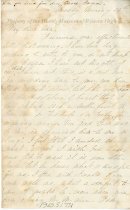
Letter headed Tuesday Morning 24th [in 1865 only January and October had a Tuesday fall on the 24th, several times Xmas is mentioned so the proper date is probably January 24th and the year must be 1865 as Lucy Minor asks about her cousin Lucy Breckinridge who passed away in June of 1865], letter written to Ann (last name not known), the writer tells of her distress at losing her loved one, mentions family friends and members. She mentions severa...
Record Type: Archive
-
-
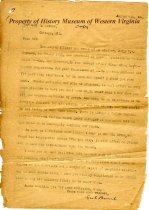
Bernard return letter to Dr. Parker - August 5, 1894
Bernard wrote to Dr. Parker in 1894, following the death of Bernard's brother. Bernard thanked Dr. Parker for his kind words, and for sending money for a copy of Bernard's book "War Talks of Confederate Veterans". He also indicated that if Dr. Parker came to visit, Bernard would take great pleasure in his company and would show him all courtesies. Dr. Parker, it appears, was a Union soldier. Bernard indicates that he enjoys opportunities for two ...
Record Type: Archive
-
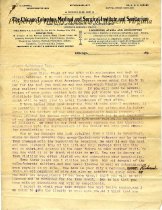
Dr. H. N. D. Parker letter - July 31, 1894
Parker is writing to Bernard informing him that he has received Volume One of War Talks of Confederate Veterans and the prospectus. He encloses payment for two copies of Volume One, and asks for extra copies of the prospectus so that he can distribute them to his Grand Army Post. Parker has looked over the book and approves of the content very much, and states that others who have interest in the late war should also approve. He will present ...
Record Type: Archive
-
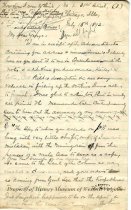
E. W. Cameron July 13, 1892 letter - July 13, 1892
Cameron writes Bernard that he has received the advance sheets containing his (Bernard's) address (presentation) and his own. Cameron already had Turner's, which Bernard had sent to Tallahassee, Florida, with the notes and additions made by Bernard. Cameron says that Keiley's letter, with Colonel Field's description, is valuable for filling in the outline that he (Cameron) finished. He was glad also that in nearly all the points the memoranda tak...
Record Type: Archive
-
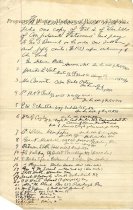
George S. Bernard subscription lists - February 11, 1896
George S. Bernard maintained a list of names of people who had pre-ordered his Volume 2 of "War Talks of Confederate Veterans." Some of the entries on the eight pages are difficult to determine, so no names are listed. On some lists there appears the address of the recipient and a reference to a letter that person wrote. The heading for the list of names is as follows: "The undersigned will each take one copy of Vol 2 of "War Talks of Confeder...
Record Type: Archive
-
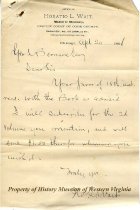
Horatio L. Wait letter - April 20, 1896
Horatio Wait writes to Bernard that he received his favor with the book, and that he will subscribe to the 2nd Volume and send the $1.50 when requested.
Record Type: Archive
-
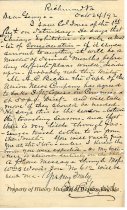
John E. Laughton October 24, 1892 letter - October 24, 1892
Laughton informs Bernard that he has seen Colonel Jones of the 1st Regiment, who said that the Chicago Exhibit was only a matter under consideration. It would be a matter of months before any plans would be decided upon, and probably not this winter. Laughton states that Mr. A. C. Becker, the superintendent of the Union News Company, will take 50 copies on commission at 50 cents each, and will take more if needed. Mr. Becker said that this is ...
Record Type: Archive
-
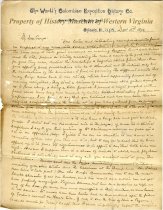
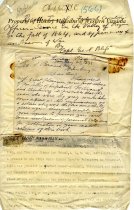
Letter from George N. Bliss to George S. Bernard pasted onto page [566] intended for book. - January 28, 1895 (letter) , 1895-1912 (page for book)
George S. Bernard, a lawyer from Petersburg, Virginia, who had served in the Civil War, collected reminiscences of veterans after the war. Some were published in the book "War Talks of Confederate Veterans." Other material was collected for a planned second volume that was not published at the time. However, some of the material intended for Volume Two was published in newspaper articles and used for speeches. The extant document appears to be i...
Record Type: Archive
-
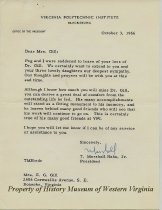
Letters of Condolence - 1966
Letters of condolence sent to Mrs. Gill after the death of Dr. Elbyrne G. Gill on September 30, 1966. The letters from friends and associates of Dr. Gill date from October 1, 1966 through November 5, 1966.
Record Type: Archive
-
-
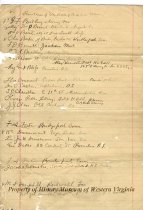
Name list for purchase of War Talks of Confederate Veterans. - February 11, 1896
George S. Bernard maintained a list of names and addresses that pre-ordered his Volume 2 of "War Talks of Confederate Veterans". The entries on the two pages are in some cases difficult to determine, so all names are not listed. The heading for the list of names is as follows. "Purchasers of "War Talks of Confederate Veterans." There is another related list under Object ID 2009.75.043.
Record Type: Archive
-
-
-
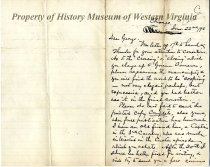
W. E. Cameron June 22, 1892 Letter - June 22, 1892
Cameron writes from Chicago to Bernard that he has received his (Bernard's) letter of the 17th. He thanks Bernard for making the corrections.The next few lines pertain to Bernard's interpretation of a word that Cameron has used in his manuscript. Bernard uses "crossing" or "closing". Cameron requests that Bernard re-examine the manuscript and that then he will find the word to be "cooping". Cameron says the word is not elegant, but expressive and...
Record Type: Archive
-
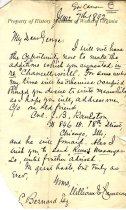
W. E. Cameron June 7th, 1892 - June 7, 1892
A note written to Bernard informing him that Cameron will not have the opportunity to make additions that Bernard had requested, about Chancellorsville. He says he will be occupied for some weeks, and if Bernard desires to write then he should write to the address given, of his old friend, Col. J. B. Raulston, in Chicago, who will forward it on to him. He asks that Bernard continue to send the "Rural Messenger".
Record Type: Archive
-
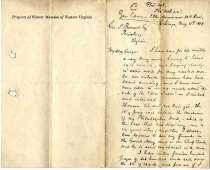
W. E. Cameron letter of May 12, 1893 - May 12, 1893
Cameron, writing from Chicago, tells Bernard that for two months he has been busy and has not been able to do much about the sale of "War Talks of Confederate Veterans." The first of June he will conclude the writing of his Philadelphia book, which has kept him busy, but then will have time for leisure and to visit old friends in the Grand Army and Confederate Camps. He says he has written fourteen hundred pages of six hundred words each si...
Record Type: Archive
-
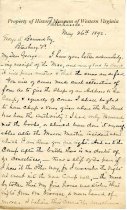
William Cameron letter of May 26, 1892 - May 26, 1892
Writing to Bernard from Tallahassee, Florida, Cameron says he has Bernard's letter acknowledging that the missive he sent has been received, and will pass muster with few errors. He asks Bernard to shape the missive into the form of an address given to the (Confederate) Camp and to quote the "War Record" as the authority, as Cameron had only memoranda and not the books. He then mentions an incident involving a Macon Martin in which he says tha...
Record Type: Archive
-
William E. Cameron December 12, 1892 letter - December 12, 1892
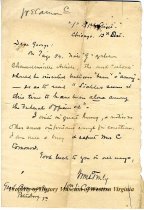
Cameron writes a brief note to Bernard bringing to his attention a correction to the Chancellorsville article. The word "alone" to be inserted between "been" and "among" so as to read as follows. "Sickles seems at this time to have been alone among the Federal officers - etc." He tells Bernard he has written in a great hurry, and also he expects his wife the next day.
Record Type: Archive
-
William E. Cameron December 5, 1892 letter - December 5, 1892
Cameron acknowledges the receipt and enclosures of a letter from Bernard, and tells him how he enjoyed reading the contribution from Sgt. Crow and the other papers recalling the men and events of the good old times. Good times they were, regardless of the hardships and tragedies. One good effect of the publication of the book will be to stimulate, not just the interest, but the recollections, of the survivors. Cameron finds himself, while reading...
Record Type: Archive