
Search Term Record
Metadata
Name |
West Point Military Academy |
Related Records
-
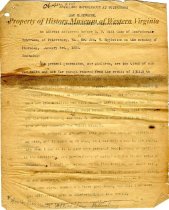
Artillery Experiences at Petersburg & Elsewhere by Dr. Joseph W. Eggleston - January 3, 1895
Eggleston's letter is fragile, the paper is aged, and the edges are beginning to break off. The type is also very light. The letter was used as a talk given to the A. P. Hill Camp of Confederate Veterans, January 3, 1895. Eggleston's opening remarks mention that the current generation shows little interest in the events that occurred between 1861-1865. They are neglecting to preserve the history for future generations. But their children will ...
Record Type: Archive
-
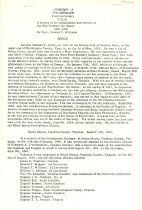
Company A, 37th Battalion, Virginia Cavalry, C.S.A.; a history - 1910
Company A, 37th Battalion, Virginia Cavalry, C.S.A.; a history of its organization and service in the War Between the States 1861-1865, by Captain George T. Williams. This typescript includes 13 pages of history followed by an Addenda, dated September 15, 1910. The addenda includes a complete roster of Company A,; a "list of those living of Company A, Dunn's Battalion, January 5, 1910", compiled by R.H. Fishburne; "those that are dead or whereabo...
Record Type: Archive
-
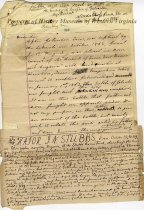
Father and Son Meet on the Battlefield by J. N. Stubbs - 1895
At the bottom of the first page of Stubb's letter, Bernard has glued this biography of James N. Stubbs. James N. Stubbs was born October 17, 1839, in Gloucester County, Virginia, and was educated at William & Mary College. He joined the Gloucester Artillery in 1861, was commissioned a First Lieutenant in 1862, and was sent to Texas to report to Gen. John Bankhead Magruder, also called "Prince John". Stubbs remained in the Trans Mississippi Dep...
Record Type: Archive
-
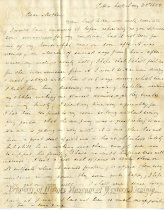
Letter - January 25, 1838
Letter headed "Pittsa Co. H. Jany 25th 1838" from George H. Gilmer to his mother Mary Gilmer, Hardin's Tavern, Albemarle, Virginia. Reports on his injured ankle, now rapidly healing; on Christmas spent with Harmer and Isabella; on his excellent house servant; discusses New London Academy as a possiblility for his brother John and opposed sending John to West Point.
Record Type: Archive
-
Newspaper article on Elliott's Brigade at the Crater - March 5, 1899
This newspaper article takes up two full pages with the first part on the front page, continuing on the reverse. The paper is deteriorating, which has resulted in some empty spaces. Four images make up the front page and four images the reverse. The first two images are advertisements and have no connection to the story. The story of Elliott's Brigade begins at the bottom half of the front page and continues on the whole of the reverse side. The ...
Record Type: Archive
-
-
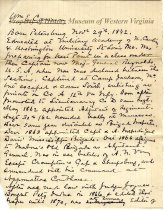
Wm E. Cameron Biography Note - Assumed 1892-1896
A Biography of W. E. Cameron. Born in Petersburg, November 9, 1842. Educated at the Military Academy of North Carolina, and Washington University, St. Louis, Missouri. Was preparing for West Point in a class under (then Captain) now Major General Reynolds, U.S.A., when war was declared between the sections. Captured at Camp Jackson, MO, but escaped and came south, enlisting as private in Co. A, 12th Virginia Infantry. Soon after, promoted to L...
Record Type: Archive